One Hundred Years Later and in a Warmer Climate – A Case of Ecotonal Treeline Change in the Swedish Scandes-Juniper Publishers
Juniper Publishers - Open Access Journal of Ecology

Introduction
Natural treelines in high-mountain regions are considered as excellent and broad-scale indicators of biological responses to climate change and variability [1-10]. Since the early 20th century, treelines of different species have advanced by maximum 200-245 altitudinal meters in the Swedish Scandes, while the forest limit has changed substantially less in elevation [3,11].
Treeline is here taken in a broad sense, as the transition zone (ecotone) between the closed forest and the treeline proper, i.e. the highest trees of a specific species, with a minimum height of 2 m. Up to the present most studies have focused on the treeline with this narrow definition, since spatially-precise early 20th century measurements exist from a large area in the Swedish Scandes. Studies of the entire treeline ecotone are constrained by lack of stringent and repeatable old records and the strongly shifting structure and configuration of this entity, which has precluded accurate inter-site comparisons over space and time [8,11-13].
Results and Discussion
Below, a compelling case, based on repeat photography, describing transformation of the treeline ecotone, from a belt of stunted and climatically constrained old-established krummholz spruces (Picea abies (L.) Karst.) into a partly treed landscape. This change is coinciding with summer (June-August) warming by 1.6 °C since the early 20th century [11].
The study site is on the south-facing slope of Mt. Mullfjället (peak 1031 m a.s.l.) in the southern Swedish Scandes (63° 24´N; 12° 25´E). Norway spruce (Picea abies (L.) Karst.) is the dominating tree species in the lower slopes and in the treeline ecotone. This is a deviation from the general situation in the Scandes, where mountain birch (Betula pubescens ssp. czerepanovii) generically forms the forest-alpine tundra transition above the coniferous belt. In this, region Picea abies has a particularly long history and appeared on isolated nunataks quite early following the deglaciation, about 13 000 cal. yr. BP [14]. The current treeline position (narrow definition) is at 880 m a.s.l., which is 80 m higher than by the early 20th century and 50 m above the view here specifically concerned.
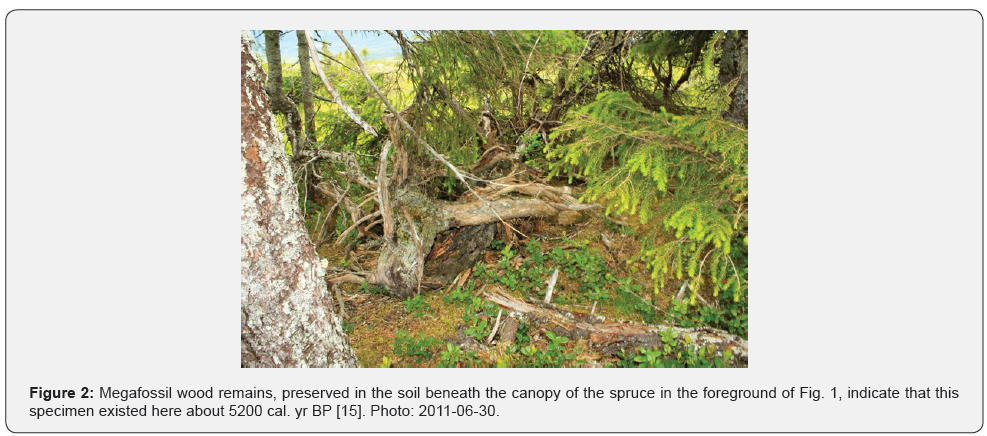
A matched pair of now-and-then photographs (830 m a.s.l.) depict fundamental structural transformation of the spruce treeline ecotone over the past one hundred years (Figure 1), when summer temperatures (June-August) increased by 1.6 °C [11]. Megafossil remains (Figure 2) indicate that one of the concerned spruces existed 5200 cal. yr BP [15].
These results add further support to general observations of ongoing climate-driven structural change in the treeline ecotone of the Swedish Scandes [11]. This is one of few cases, with Picea responding progressively at the broad landscape scale to secular climate change. Possibly, this anomaly ultimately relates to the local maritime climate [16] and the long-term (Holocene) dominant presence in the region. Predominantly, spruce progression is accomplished by phenotypic transformation of oldage and stunted and layering maritime climate, rather than spread and establishment of new individuals. This appears to be the general mode of subalpine spruce response to climate warming in the Scandes [17].
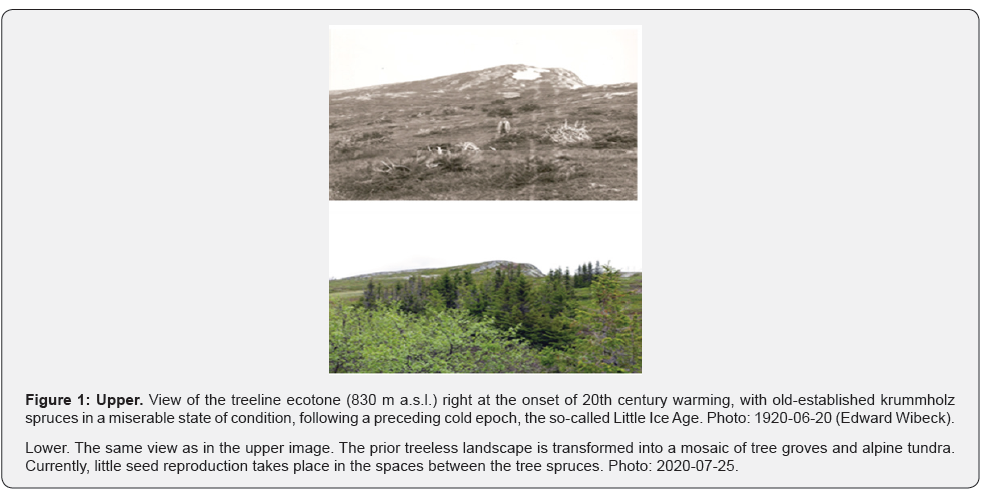
Prior to the onset of present-day climate warming, a pool of krummholz specimens existed above the treeline. Possibly, they originated from early-Holocene pulses of immigration and spread. It is a well-established fact that still living clonal spruces in the treeline ecotone may date more than 9000 years of age. That is close to the deglaciation of mountain valleys [18] and, as mentioned above, mountain peaks had harboured spruce 4000 years earlier. As this pool becomes increasingly depleted when these spruces transform into tree-size, little further spruce treeline advance is likely to occur.
please click on: https://juniperpublishers.com/ecoa/index.php

Comments
Post a Comment